
Before We Dive Into Vibe Coding
A new way of building with AI and intuition
Vibe Coding is more than just a buzzword — it’s a fresh approach to software development where humans and AI collaborate seamlessly. Instead of writing long lines of syntax, developers simply describe their intent, and AI converts those ideas into working code.
Imagine saying: “Build a simple app with login and dark mode.”
Within seconds, an AI-powered system generates the structure, fixes errors, and optimizes the flow. No endless boilerplate, no syntax struggles — just pure creativity turning into reality.
In 2025, Vibe Coding is rising as the bridge between imagination and execution. It’s faster, smarter, and more intuitive — where humans set the vision, and AI makes it happen.
How Vibe Coding Works
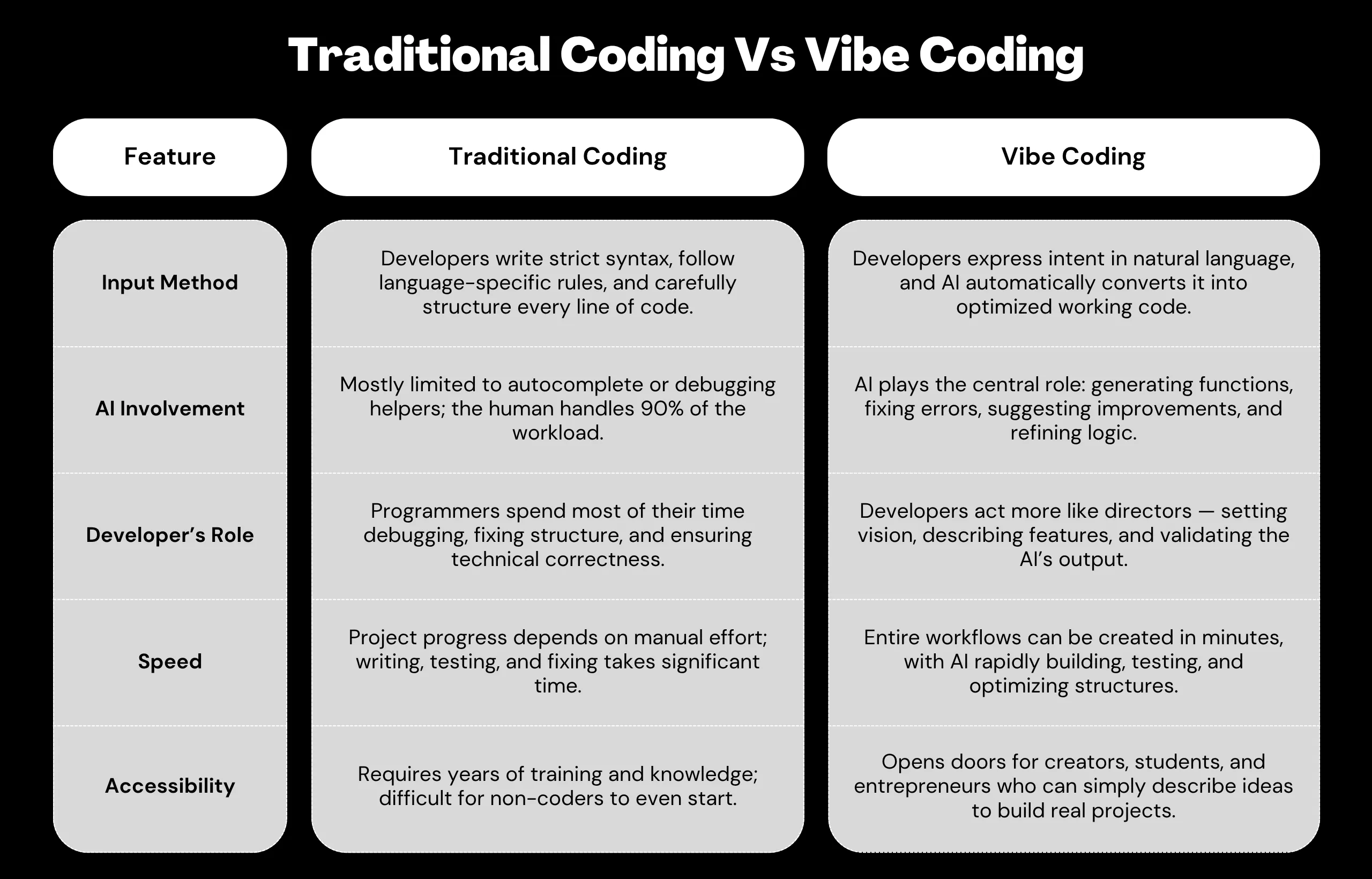
Traditional coding means writing endless lines of syntax, fixing errors, and repeating the cycle until everything runs.
Vibe Coding flips this process. Here, you don’t write code line by line — you simply describe what you want, and the AI takes care of the rest.
Think of it like giving directions to a teammate:
"I need a notes app with search and cloud sync."
Instead of typing every command, the AI interprets your intent, builds the structure, and even optimizes it. You focus on ideas, not boilerplate.
Agentic Coding and AI Tools
If Vibe Coding is about building with intuition, Agentic Coding takes it one step further.
Here, AI doesn’t just follow your instructions — it acts like an autonomous teammate.
These AI agents can break down tasks, collaborate with each other, and improve results without you guiding every single step.
Imagine telling an AI:
"Build a blogging platform with user accounts, comments, and dark mode."
Instead of only generating code, the agents split the work — one sets up authentication, another manages UI, while another optimizes performance.
The result? A project built faster and smarter than any solo developer could manage.
Top 5 AI Tools for Vibe Coding




These tools represent the new wave of development in 2025 — where humans don’t just write code, they direct intelligent systems to build with them.
Benefits and Challenges
Like every big shift in technology, Vibe Coding comes with both opportunities and risks.
Here’s a quick look at what makes it exciting — and what we need to watch out for.
✅ Benefits
- Speed: Build prototypes in minutes instead of days.
- Accessibility: Even non-coders can turn ideas into apps.
- Creativity: Developers focus on vision and design, not boilerplate.
- Error Reduction: AI auto-fixes syntax and common bugs.
- Collaboration: AI agents work like extra teammates.
⚠️ Challenges
- Security Risks: Auto-generated code can have hidden vulnerabilities.
- Over-Reliance: Developers may lose touch with core coding skills.
- Bias in AI: AI reflects the flaws in its training data.
- Lack of Control: Sometimes output feels like a “black box.”
- Trust Factor: Teams need strong review practices before production use.

The Future of Coding
Technology never stands still — and neither does the way we build it.
If we look back, every decade has reshaped how software is made:
- Traditional Coding: Developers writing everything line by line.
- Low-code Platforms: Drag-and-drop tools speeding up workflows.
- No-code Builders: Empowering non-programmers to create apps.
- Vibe Coding: Natural language meets AI, code flows from intent.
- Agentic AI: Autonomous AI agents collaborating like human teams.
A Glimpse Ahead
In the coming years, coding might feel less like typing and more like designing conversations with AI.
Developers will set the vision, while fleets of intelligent agents bring it to life.
The line between developer and creator will blur — making technology accessible to anyone with imagination.
Conclusion
Vibe Coding is not just another tech trend — it’s a glimpse into how software will be built in the future.
By shifting the focus from syntax to intent and creativity, it empowers developers, students, and even non-coders to bring ideas to life faster than ever before.
Agentic Coding takes this one step further, showing us a world where AI agents collaborate like teammates, building complex systems with minimal human effort.
We are standing at the beginning of a new era in development — one where imagination fuels execution.
The question is no longer “Can I code this?” but rather “What do I want to build?”
Stay tuned with Rangrove Suite as we continue to explore the tools, trends, and ideas shaping the future of technology.